

Surrey's network of grass verges stretches alongside 3,000 miles of urban and rural roads, providing a great chance to improve plant and insect diversity through careful management.
Some of our highway verges are very important habitats for wildlife. We call these conservation verges. We are introducing a new approach to help manage and protect these special areas.
Many residents are eager to improve the biodiversity of highway verges that are adjacent to their property and participate in what we call the Blue Heart Verges scheme in Surrey. These verges follow the principles of the Blue Campaign, founded in 2014 by wildlife filmmaker Fergus Beeley. On these verges, the number of grass cuts is reduced, allowing native plants to thrive. In some areas, additional steps such as preparing the ground and sowing wildflower seeds are also taken.
We are improving the way Blue Heart verges are managed to help more plants and wildlife thrive. This will also make grass cutting simpler, as different verges on the same road may currently be cut in different ways.
Page contents
- Conservation verges
- Amphibian verges
- Botanical verges
- Our standard grass cutting programme
- Blue Heart verges
Conservation verges
Our Conservation verges fall into two categories:
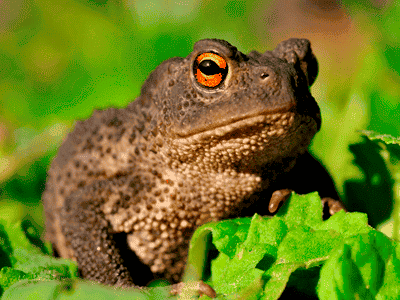
- 33 verges identified as important for amphibians, particularly the Common Toad.
- 43 verges identified for their botanical value, important for plant species and wildflowers.
Amphibian verges
Amphibians spend most of their lives on land, often a long way from water. In spring, they travel to ponds to breed and often return to the same pond each year. Common toads are especially loyal to their breeding ponds and may need to cross roads on their journey.
We have registered these verges are registered as toad crossings. To protect the toads during their migration (from 14 February to 31 March), our approach is not to allow any planned road works on these sections of road during this period. Any emergency road works will still be permitted.
Botanical verges
These verges are identified as having plant species of ecological interest.
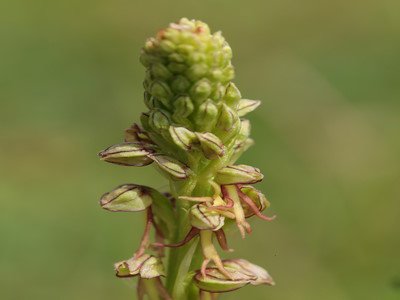
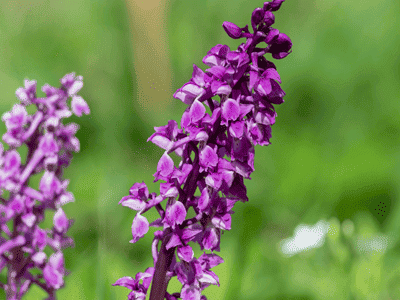
Examples of rare plant species found on roadside verges in Surrey are:
- Man Orchid
- Early Purple Orchid
The Plantlife good verge guide states that proper management is essential to maintain flower rich habitats on road verges. Without it, many grassland flowers quickly disappear, and coarser vegetation takes over, eventually turning uncut verges into scrub and woodland.
We aim to manage these conservation verges differently from the standard rural and urban grass cutting programmes to preserve the identified plant species.
To help plants thrive, it's crucial that they grow, flower, and set seed. Cutting plants before they flower deprives insects of nectar and stops plants from reproducing. Regular and early cutting can quickly eliminate some species.
Removing grass cuttings helps reduce the growth of vigorous plants that out-compete others, lowers soil nutrient levels, and removes dead vegetation, providing space for new seeds to germinate.
There are three cutting regimes for managing botanical conservation verges, all of which involve removing the cut vegetation:
- Cut A in April: For verges with summer-flowering species requiring two cuts.
- Cut B in August: For verges with species active in June and July.
- Cut C in September to October: For all other verges and those requiring two cuts.
Some conservation verges have areas of scrub that have spread and are crowding out native plants. Our ecologists check these verges and will advise if the scrub needs to be cleared before the normal grass cutting takes place.
Our standard grass cutting programme
The standard for grass cutting across Surrey is 6 urban cuts, 2 rural cuts and 2 high speed road cuts every year. In general, an urban area is a built up area with a speed limit of 40mph or less. A rural road is one which tends to have a lower density of buildings than an urban road and is often tree and hedge lined.
We do not collect grass cuttings following mowing, but they should be spread evenly over the surface. We acknowledge and understand the advantages of removing grass cuttings, but raking up, loading, transporting and disposing of grass cuttings would increase our costs substantially.
Details on our grass cutting programme can be found at: Grass cutting, verges and weeds.
Blue Heart verges
The goal of Blue Heart verges is to increase biodiversity by reducing the number of grass cuts per year on specific verges, allowing wildflowers and the insects that rely on them to thrive.
When residents apply for a Blue Heart verge, we assess whether it is suitable for the scheme. We look at how it could benefit wildlife and whether it can be managed safely.
Blue Heart verges are usually cut once a year, with the cut grass raked up and removed at the end of the growing season, usually in October. Plaques are normally installed to show that the verge is part of the scheme and to help our contractors identify it.
Not all verges are suitable for the scheme. In some locations, allowing plants and grass to grow longer could affect road safety.
Residents who take part in the Blue Heart scheme are encouraged to remove litter where it is safe to do so. Removing cut grass helps keep soil fertility low and stops the cuttings from rotting on the verge. This creates better conditions for wildflowers, which often grow best in poorer soils.
For safety reasons, we must keep clear sightlines at junctions and access points. Parts of Blue Heart verges will also be cut to stop plants from growing onto roads and pavements.
Larger verges have often been the most successful. One example is the Blue Heart verge on the A246 Guildford Road in Bookham, north-east of Rectory Lane.
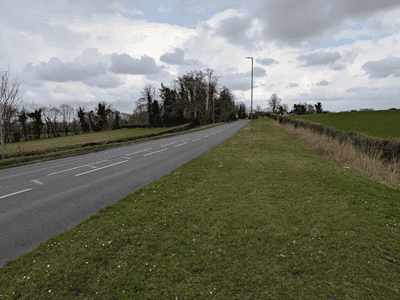
We previously supported smaller Blue Heart verges outside individual properties. These are usually less successful. They often have more coarse vegetation than wildflowers, which can lead road users to believe the verge has been overlooked during grass cutting, resulting in complaints.
New process to participate in Blue Heart Scheme
We’ve reviewed and updated our process to make it easier for communities to improve local biodiversity through the Blue Heart scheme.
- Applications for Blue Heart verges: We now only accept applications from community groups, rather than individual residents.
Minimum Verge Size for Blue Heart verges: A new minimum size requirement has been introduced.
- Where the verge is between the road and pavement (footway): 3m wide x 10m long
- Where the verge is between the highway boundary and pavement: 2.5m wide x 10m long
- Where the verge is between the highway boundary and the road: 2.5m wide x 10m long
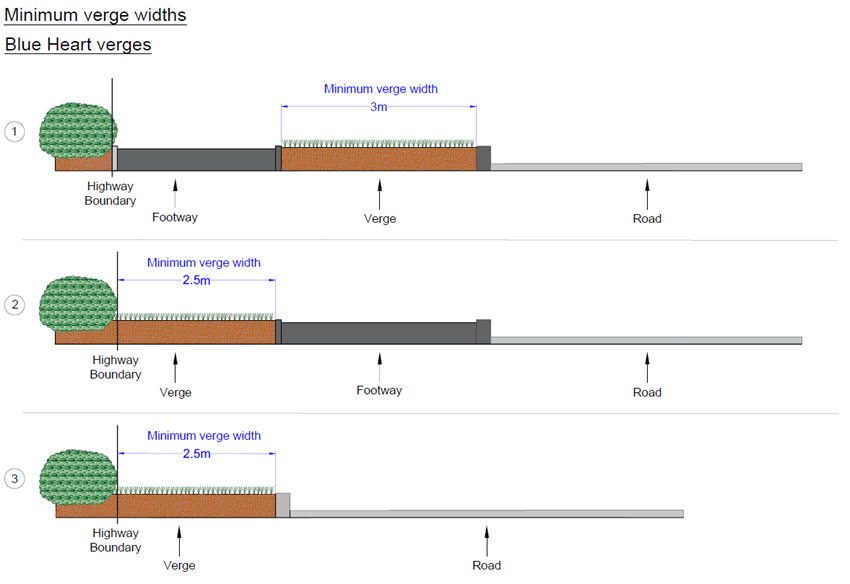
There is the need for us to leave a 0.5m strip at the edges of any Blue Heart verge next to roads or pavements. This helps to prevent vegetation from growing into the road or pavement and causing an obstruction. These dimensions allow for a minimum 2m width and 9m length of wildlife habitat.
Why these sizes?
We’ve determined these sizes based on the Lawton principle, which states that nature recovery works best when it is functionally connected to other nature-rich areas, providing a vital habitat for protected species.
The Lawton principle came from the 2010 report Making Space for Nature.
Do you want to install a Blue Heart in the verge?
If your application is successful, we will install a Blue Heart marker, so it is readily identifiable.
We will continue to support existing Blue Heart verges that do not meet the new minimum size requirements by cutting, raking and removing the vegetation at the end of the season, until residents advise us otherwise. Please do this using Fix My Street.
All of our contractors know which verges are part of the Blue Heart scheme and that they are maintained differently from other roadside verges. These verges are clearly marked and shown on our maps.
Although we take care to avoid mistakes, a Blue Heart verge may occasionally be cut by accident. If this happens, our contractors will repair, reseed or replant the area at no cost to taxpayers. Where needed, they will also inform the resident or organisation that helped set up the Blue Heart verge.
How to apply for a Community Blue Heart verge
- Contact your local Surrey County Councillor. You can find contact details here: Find Councillor.
- Reach out to your Parish or Town Council or Residents’ Association, if applicable.
- Discuss your Blue Heart verge proposals with your neighbours to gather support.
- Ensure the verge you want to apply for meets the new minimum size requirements.
You can apply via Fix My Street. Please include the following information:
- Name of your group (if it's a formal group). If you're a group of neighbours or residents, please state this.
- The location of the verge (you can use a map to indicate its location).
- Attach a plan outlining the verge. You can take a screenshot from the Surrey Interactive Map.
- Have you contacted your County Councillor? What was their response?
- Have you consulted with local groups or organisations about your Blue Heart Verge proposals? What feedback did you receive?
What happens next?
We will assess your application for a new Blue Heart verge within 28 days and let you know whether it has been successful.