

What are Electric Vehicles?
Electric vehicles (EVs) are cars, vans and other motor vehicles that have battery powered electric motors, unlike conventional petrol or diesel powered vehicles, also known as internal combustion engine (ICE) vehicles. Electric vehicles do not produce the exhaust pipe emissions, that lead to climate change and poor air quality in our communities.
The sale of new petrol and diesel cars will be banned in the UK from 2035, and many car manufacturers now offer a selection of electric vehicles within their range.
Hybrid vehicles have both a petrol or diesel and an electric motor that reduces exhaust pipe emissions, but they will no longer be sold after 2035 as only cars with zero carbon emissions will be sold beyond that date.
Types of Electric Vehicle
There are four main types of electric vehicle:
- Fully electric vehicles, known as a Battery Electric Vehicle (BEV): a vehicle solely powered by batteries which needs to be plugged in to be charged. These will be sold beyond 2035.
- Plug in range extended vehicle, known as an Extended-Range Electric Vehicle (E-REV): a vehicle powered by batteries, but with a small petrol/diesel generator fitted, that can help extend the range of the vehicle by topping up the batteries while driving. A decision is awaited on whether these will be sold beyond 2035.
- Plug-in Hybrid Electric Vehicles (PHEV): A vehicle which can be powered both by electric and a conventional diesel/petrol engine. It can both be plugged in and fuelled conventionally. The vehicle is driven by either or both engines to generate maximum efficiency. Sale of new PHEV cars will be banned from 2035.
- Conventional hybrid, known as a Hybrid Electric Vehicle (HEV): these vehicles have a conventional petrol/diesel engine that is supported by an electric motor, which means higher carbon emissions than any of the above types of vehicle. Sale of new HEV cars will be banned from 2035.
Electric vehicles are usually extremely quiet to drive and do not produce exhaust emissions, however they still produce some local air pollution due to brake and tyre wear, as well as CO2 emissions associated with producing electricity. All public chargepoints installed as part of Phase 3 of our chargepoint rollout are powered by 100% renewable energy.
Electric Vehicle uptake
As of February 2024, 1 million battery electric vehicles have been registered in the UK, with BEVs making up 21% of new car sales. Statistics on new vehicle sales are regularly published by the Society of Motor Manufacturers and Traders and the Department for Transport.
Surrey's on-street public chargepoint locations
The number of public chargepoints on Surrey's highways (also called on-street chargepoints) is growing daily. There is also an increasing number of chargepoints in public car parks managed by District and Borough Councils. A lot of publicly-accessible EV chargepoints are owned and operated by private companies, such as at shops and shopping centres, or petrol stations. There are several public charging networks operating in the Surrey area.
The best way to find your nearest chargepoint is by using the Zap Map website. This is regularly updated to show the latest public chargepoint locations, including on-street chargepoints managed by Surrey County Council, as well as chargepoints managed by other operators.
Types of public chargepoint
Electric vehicles can be charged using an alternating current (AC) or direct current (DC) charging system. Most EVs can accept either type, although some older models may only accept AC.
We are looking at installing a number of public chargepoint on Surrey's Highways over the coming years. These can be split into three categories:
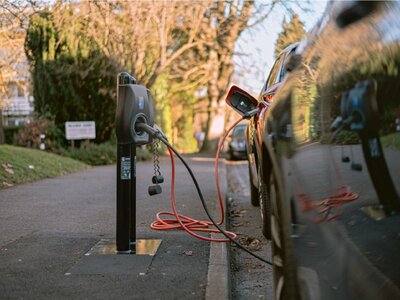
- Fast AC chargers (7 or 11 kWh): these are the most common type of public chargepoint. They are standalone devices which normally have two sockets per device. These can charge a typical EV in 3 to 6 hours, depending on the achievable charging speed and the size of the battery.
- Slow/ Standard AC chargers (3.5 to 5kW): in areas where fast chargers are not feasible, we may install charging sockets in lamp posts. These deliver a slower charging rate compared to fast chargers.
- Rapid DC chargers (50kW and above): in areas of high expected demand we may install rapid chargers. These can charge compatible EVs from 20% to 80% charge in less than 1 hour. These normally have a higher user tariff compared to AC chargers, due to the cost of the chargepoint equipment.
At an AC charger you normally use your own charging cable. The vast majority of chargers and EVs use the 'Type 2' connector, although some older models such as the Nissan Leaf use a 'Type 1' connector which may require an adapter. Rapid chargers always have their own integrated charging cable.
More information on chargepoint types is available at Gov.uk Commercial Chargepoints Specification.
About Surrey's on-street electric chargepoint rollout
Since 2019 Surrey County Council has been rolling out public chargepoints across the county to enable EV ownership, particularly in areas with limited off-street parking. In 2020 there were only 6 on-street chargepoint sockets across Surrey. By October 2024, there were over 200 EV chargepoints sockets installed on behalf of Surrey County Council.
In February 2023, the Council signed a contract with Connected Kerb Ltd to install thousands of public chargepoints across the county over the next 5 years. Through this contract, chargepoints are being installed at convenient on-street locations in residential areas and high streets.
Connected Kerb will install a mix of chargepoints, depending on location, to suit all needs. This will include:
- Standard 7kW chargepoints
- Slower 3-5kW lamp post chargepoints, in locations where bollard chargepoints are not feasible
- Rapid chargepoints (50kW+) in areas of high expected demand, however these will be better suited to car parks and will be installed on-street on a case-by-case basis.
Read the press release about our contract with Connected Kerb for more information.
How to use the on-street electric vehicle chargepoints
Using the chargepoints
To charge your vehicle, you need to park in the EV space, plug your car into the chargepoint and then start the charge via the chargepoint operator website or mobile app.
The chargepoint operator details are labelled on the chargepoint unit.
Once your car is charged you should unplug and move your car ready for the next user. Please bear in mind some chargepoint bays have a maximum stay time, this will be indicated on nearby signposts if applicable.
Paying for charging
You can pay for a session without registering as a user by going to the operator's website and providing payment card details. Please visit these web pages for more information:
Cost of charging
As of Tuesday 22 April 2025, a new tariff has come into effect. The tariff is:
- 50p per kilowatt hour for Mer operated chargepoints
- A smart tariff, with no connection fee, for chargepoints operated by Connected Kerb are:
- 53p per kilowatt hour for charging between 7am and midnight
- 43p per kilowatt hour for charging between Midnight and 7am
- A standard charging tariff for lamp column chargepoints is:
- 50p per kWh for charging at all times
More information about the smart tariff charges and how to use it can be found on Connected Kerb's website.
You can find out who the chargepoint operator is by looking on Zap Map's charge point finder, or by the information on the chargepoint itself.
If a parking fee applies in the area of the chargepoint then this will be applied to your bill in addition to any charging fees. The charging and parking costs will be integrated and payable together with the charging tariff.
Reporting an issue with a charger
If you are experiencing an issue with a Mer chargepoint, please contact their 24/7 helpline on 020 3884 2768.
For non-urgent enquiries, please email: hello.uk@mer.eco
If you are experiencing an issue with a Connected Kerb charge point, please contact their 24/7 helpline on 0800 0291 696.
For non-urgent enquiries, please email: support@connectedkerb.co.uk
Requesting a public chargepoint
Requests for public on-street chargepoints can be made using our interactive map Have your say today about Surrey EVs on Commonplace.
Domestic Kerbside Charging trial
Overview
For electric vehicle (EV) users with off-street parking, charging at home is usually the cheapest and most convenient option. However, as trailing a cable across the pavement is considered unlawful in Surrey and most places across the UK, Surrey residents who don't have off-street parking cannot currently charge their EV at home.
New products are emerging to try and address this issue and make home charging more widely accessible.
We want to test these products in Surrey:
- Cable gullies - cable gullies are channels installed in the pavement that can be used to safely trail an EV charging cable across a pavement. Trials have been taking place in Oxfordshire.
Please note that the product does not give residents the right to reserve a parking space by their house, and therefore you must be able to park there regularly to take part in these trial. In addition, please note that the trial is solely for residents who do not benefit from off-street parking.
Cable gullies
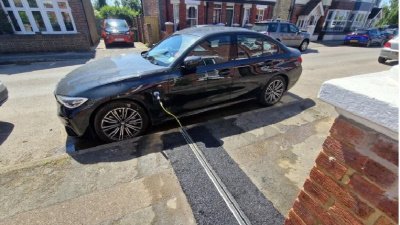
Cable gullies are channels installed in the pavement that can be used to safely trail an EV charging cable across a pavement. Trials have been taking place in Oxfordshire, and we are currently undertaking trials in Surrey.
How is the trial administered?
Surrey County Council will manage the installation and maintenance of the cable gullies. Their use will be controlled through a license issued by Surrey County Council to the resident. Surrey County Council will retain the ownership of the cable gullies.
To take part in the trial, we expect residents to agree to use the cable gully for a minimum of 3 years. License holders must inform the council if they no longer live at the licensed address.
How much will it cost me?
Costs to take part in the trial will be as follows:
- £773 for the initial license and installation of the cable gully
- £97 for the yearly license renewal
For the first year of the pilot this also includes the cost of a home wall charger installation, which will be arranged by the council. In later stages of the pilot residents may need to arrange their own home chargepoint installation separately (typically £800-1000 for a standard installation, separate discounts/ grants may be available).
Please note that residents taking part in either pilot are advised against charging an EV using a standard 13 amp 3-pin socket. This does not comply with current electrical wiring regulations, and can lead to potential electrical safety and fire risks.
How do I apply to take part in the trial?
Please note the survey is now closed to new applications while we complete the first round of cable gully installations. This survey may be reopened at a later date that is yet to be confirmed.
Trial outcomes
Surrey will be one of the first local authorities to pilot these products therefore this is initially being tested on a trial basis. The trial is expected to run for a minimum of three years.
We're proposing to install up to 30 cable gullies in the first year of the trial, subject to demand, with new quotas agreed with Surrey County Council Highways each year thereafter.
A number of factors will be monitored to ensure the success of the trial, including but not limited to:
- Is there a demand for the product and do residents that have it installed keep renewing their license?
- Does the product cause issues in terms of highways maintenance, utilities, etc.?
- Does the product cause issues to other users of the highways and is the council receiving complaints about it?
If it is decided that the cable gully trial is unsuccessful and that existing cable gullies should be removed, the residents will be reimbursed for their initial cost, but not the yearly license renewal.
What if I cannot take part in either trial?
This experimental pilot is part of a range of EV charging solutions that the council is working on deploying across Surrey. Surrey County Council is also increasing the number of public chargepoints in the county. Please visit About Surrey's on-street electric chargepoint rollout for more information.
Another potential alternative solution is for households with off-street parking to share their home charger with other users via a community charging service. Visit Co Charger for more information.
EVs and the Local Transport Plan 4 (LTP4)
EVs and EV car clubs will be key in our aim to reduce the number of polluting vehicles on Surrey's roads to achieve net zero transport carbon emissions by 2050. Our policy area Promoting Zero Emission Vehicles (ZEVs) policy area sets out our plans to increase uptake by providing more chargepoints across Surrey and raising awareness of the benefits of EVs.
Our LTP4 page for businesses explains how EV car club fleets and changes to goods deliver methods can help reduce carbon emissions.
Our Electric Vehicle strategy (currently under review) sets out how we will support and promote EV uptake in Surrey.
Switching to electric
If you are thinking of switching to an electric vehicle, you may find it helpful to read the Energy Saving Trust's information on making the switch and the Department for Transport's Beginners guide to going electric.
EV grants for Surrey fleet operators
National Highways currently offer a grant for businesses in the Guildford area to support the cost of purchasing electric vans. For more information and eligibility criteria, please visit Surrey's Greener Future – Business Grant Programmes.
Providers of community transport services for Surrey County Council (such as assisted travel to school) may be eligible for a grant towards electric vehicle purchase and chargepoint installation costs. Please contact electricvehicles@surreycc.gov.uk if you are interested in applying.
Questions and answers
Where can I charge my electric vehicle?
For some people who have off-street parking, most EV charging can take place at home. However, for a significant proportion of the population who do not have off-street parking, alternative charging facilities are required.
The private sector is installing chargepoints, with more than 600 currently available across Surrey. The Districts and Boroughs in Surrey are responsible for many of the public car parks, and are installing EV chargepoints, with more than 70 in operation and more planned. We, Surrey County Council, as the highway authority are also trying to tackle the climate emergency by installing on-street chargepoints across the county.
The number of public chargepoints is growing daily and your employer may also provide a chargepoint at work. To find your nearest chargepoint, visit Zap Map website or Open Charge Map.
Requests for public chargepoints can be made using our interactive map Have your say today about Surrey EVs on Commonplace.
People who have off-street parking and have a home chargepoint fitted may choose to share their chargepoint via a community charging app. Please visit community charging websites such as Co Charger for more information.
How much does an electric vehicle cost to charge?
Electric vehicle running costs are often lower than those of a conventional petrol or diesel vehicle. The costs of charging vary considerably depending on where you charge and the speed of the charge. The convenience of a faster chargepoint is often more expensive. It is usually most economical to charge an EV at home using your domestic electricity tariff. Where we have installed chargepoints on-street, the tariff will aim to be similar to comparable chargepoints.
Fully electric and plug-in hybrid vehicles can be particularly cost effective for higher mileage drivers where their daily distance travelled is within the vehicle range or where charging is available at work. Fully electric vehicles are also exempt from the London congestion charge.
How long does it take to charge an electric vehicle?
Charge times vary from model to model because of their battery size and the maximum charge rate they are designed to accept. There are a number of options for charging electric vehicles either in your home or at a public charging station.
- 'Slow' points use a standard 3 to 7 kilowatts per hour (8 or more hours for a full charge)
- 'Fast' points 7 to 22 kilowatts per hour (3 to 6 hours for a full charge)
- 'Rapid' points 50 kilowatts per hour or greater (typically 80% charge in 40 minutes)
Ultra-fast chargepoints can deliver even faster charging speeds for those vehicles capable of higher charging rates.
How far can an electric vehicle travel without recharging?
The range of modern electric vehicles has been increasing over recent years and the latest consumer models have a range of 250 or even 300 miles on a full charge. Some models can have significantly shorter ranges of 100 miles or less and as batteries get older range may also be adversely affected.
What are we doing to increase availability of chargepoints?
We are currently working towards the wider rollout of EV on-street chargepoints across the county. We are scaling up installations through the procurement of a long-term concession arrangement with the private sector funding and operating chargepoints.
We have currently installed over 200 public chargepoints across six Surrey districts. Please visit About Surrey's on-street electric chargepoint rollout for more information.
We are also continuing to collect information from people about where they would like chargepoints in future through our EV map Have your say today about Surrey EVs on Commonplace.
We are intent on upholding our commitments to improving air quality and addressing the climate change emergency. We believe that the private sector has a significant role to play in providing EV chargepoints, in EV forecourts, supermarkets, and other retail car parks. Boroughs and districts in Surrey will also continue to play an important role by continuing to install chargepoints in public car parks.
What about lamp post chargepoints?
We are looking to prioritise sites where 7 Kilowatt dedicated charging devices can be installed, as these will typically lead to a faster charging experience and service more users in a given period of time.
Lamp post charging supports slow 3kw charging, equivalent to a standard 3 pin power outlet. This type of charging can be used as an option for locations where the available power supply or other local constraints do not support faster charging. We are developing a long list of potential suitable locations across the county to evaluate. If you have any suggestions for suitable locations for lamp post charging within Surrey, please submit these to Have your say today about Surrey EVs on Commonplace.
Can I charge my electric vehicle outside my house?
If you have space on your own property with sufficient off-street space to park your vehicle, it is possible to have a dedicated fast charge point installed at your home. For guidance on applying for a dropped kerb at your property, including costs, please see the vehicle crossovers or dropped kerbs webpage.
To determine if you require planning permission to install electric charging points at your property, you will need to contact your district or borough council. If you have off-street parking, planning permission is usually not required.
We are often asked about trailing a charging cable from a property across a public footpath. Under the Highways Act 1980, Part IX Lawful and Unlawful Interference with Highways and Streets, it is illegal for any person to place or run a cable or wire along or across a public highway. Having the cable trail from a home, across the footway to a car may cause a safety hazard to pedestrians who are entitled to safely use the full width of the footway. Therefore, we do not allow this, even with a cable ramp or mat being used, although potential solutions are being investigated under our domestic kerbside charging trial.
Requests for public chargepoints can also be made using our interactive map and survey: Have your say today about Surrey EVs on Commonplace.
Funding for workplace or home EV charging?
Unfortunately, we do not offer any financial assistance for workplace or home charging infrastructure at this time. However, you may be eligible for some assistance available from government, through the EV chargepoint grant:
Grant schemes for electric vehicle charging infrastructure (GOV.UK)
National Highways currently offer a grant for businesses in the Guildford area to support the cost of purchasing electric vans. For more information and eligibility criteria, please visit Surrey's Greener Future – Business Grant Programmes.
Providers of community transport services for Surrey County Council (such as assisted travel to school) may be eligible for a grant towards electric vehicle purchase and chargepoint installation costs. Please contact electricvehicles@surreycc.gov.uk if you are interested in applying.
How have you chosen your on-street chargepoint locations?
Sites are selected taking into account a number of factors including amount of off-street parking, vehicle ownership, traffic, existing infrastructure, proximity to housing, power supply, and resident requests.
Will I lose parking space near my home when you install an on-street chargepoint?
In most new chargepoint locations, any vehicle, whether electric vehicle or not, will be able to park. So, all residents will still be able to use the parking bays when the EV chargepoints are installed. If there are existing parking restrictions in place, such as a permit scheme or limited parking hours, these will remain unless otherwise stated.
Any changes to parking regulations in the future will need to undergo a statutory Traffic Regulation Order (TRO) public consultation process. In a limited number of locations traffic orders to restrict parking are planned. Affected residents will receive a letter notifying them of proposals where this is the case.
I understand chargepoints are being proposed along my road but don't think there are many EV owners here, so why have you chosen this location?
Chargepoint locations take into account both existing and future demand across the county. We will continue to increase the provision of public chargepoints to ensure Surrey is equipped to meet future demand, ahead of the scheduled ban on sales of petrol and diesel vehicles in 2035.
Will you be installing on-street chargepoints in locations where there are already chargepoints nearby?
We will continue to increase the provision of public chargepoints to ensure there is a comprehensive network that is equipped to meet future demand. Whilst we will seek to spread chargepoints across the county, there will be occasions where new chargepoints may be installed near existing installations to meet demand in an area.
I live near a location where new chargepoints are proposed and am concerned EV users will leave their cars here for longer and come from other roads to park. How will you manage this?
We are able to monitor the utilisation of chargepoints to understand how often and how long users charge their vehicles. Over time and as the number of chargepoints and electric vehicle users grow we plan that more and more residents without access to off-street charging will have local and convenient places to charge.
How are you enforcing bays to be electric vehicle only, or will you have restricted timeframes for parking or charging?
We do receive responses from residents that do not use electric vehicles concerned about loss of parking for their vehicles and it is for this reason that we are currently installing most EV parking bays without EV only restrictions. Existing parking restrictions such as maximum timeframes, permit holders only, or fees will be maintained. In instances where parking by chargepoints is only to be used by electric vehicles, we will undertake a statutory TRO consultation.
We are able to monitor the utilisation of chargepoints to understand how often and how long users charge their vehicles which will help us to assess any changes required to EV parking bays. We welcome feedback from EV users who are continually not able to access particular bays to charge their vehicles; if a significant number of complaints are received for a site then we will review the need for a TRO.
Why is Surrey County Council not installing in more car parks?
We own and operate a small number of car parks, however, the majority of public car parks are operated by district and borough councils, or by private organisations such as supermarkets, petrol stations, other businesses or residencies etc.
How are the chargepoint locations designed to maintain safe car and pedestrian routes?
The chargepoints are positioned to leave enough pavement width to allow pedestrians, including those with wheelchairs and prams, to pass them comfortably. In addition, we will only install chargepoints where parking would still provide sufficient width for emergency vehicles and not impede safety down a road or near a junction.
I live in a parking permit zone and am worried that installing electric vehicle chargepoints will encourage other drivers who do not hold a permit to charge their EVs here, will this be the case?
Unless explicitly stated when advertising a potential location, we are not proposing to change usage of parking in permit zones, except to add electric vehicle chargepoints. Any changes to parking regulations will need to undergo a statutory Traffic Regulation Order consultation process.
I have other concerns about the road, how can I report them?
Please report any other highways issues on FixMyStreet.
Related links and contacting us
Related links
- Electric Vehicle strategy
- Promoting Zero Emission Vehicles (ZEVs) policy area
- Office for Zero Emission Vehicles (GOV.UK)
- UK electric vehicle infrastructure strategy (GOV.UK)
- Low emissions vehicles eligible for a plug-in grant (GOV.UK)
- Transitioning to zero emission cars and vans: 2035 delivery plan (GOV.UK)
- Compare electric cars: Find the best EV for you (Love my EV)
- Ultra low emission vehicles: tax benefits (GOV.UK)
Contact us
If you have any further questions or comments, please email: electricvehicles@surreycc.gov.uk