

Cycling facilities are pieces of infrastructure that are intended to make riding a bike more enjoyable and appealing to everyone. Some facilities create a dedicated space for cycling whilst others make it easier and safer to share space with other users such as pedestrians, horse riders and motor vehicles.
Cycle facility design guidance in England was amended by Government in 2020 with the release of Local Transport Note 1/20: Cycle Infrastructure Design. The guidance shall assist, rather than replace, our responsibility as Local Transport/Highway Authority to determine the most suitable arrangements for cycling on its network. When planning improvements, we will adapt the design of facilities to consider local circumstances, available funding and so forth.
You can find cycle facilities near you by using our interactive Cycle Facility Map. The types of cycle facility shown below are illustrative examples taken from the new guidance.
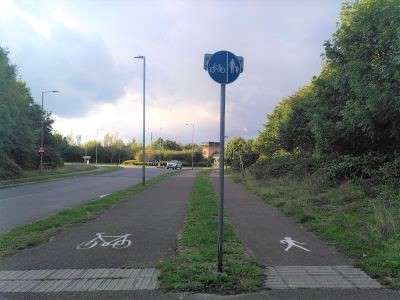
Cycle tracks
A 'cycle track' is the technical name for a dedicated space for cycling along a road, distinct from both the carriageway and footway. Cycle tracks should be designed so that it is easily recognised as a space intended for cycling rather than walking, driving or parking. For instance, they can be built at a different level to the carriageway and footway to introduce a height difference, utilise a different surfacing material or be separated from other traffic with a kerb or grass verge.
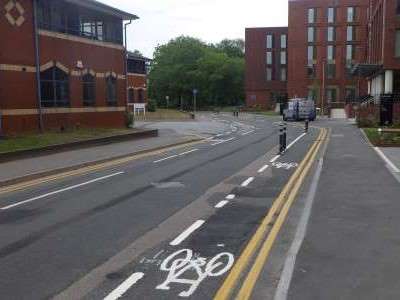
Cycle lanes
Cycle lanes are painted on the carriageway, marking out a space for cycling amongst other vehicle traffic. Advisory cycle lanes with broken white lines can ordinarily be entered by other vehicles, whilst mandatory cycle lanes with solid white lanes ordinarily cannot. The 2020 update to government guidance now recommends the use of protective features such as wands to additionally protect cycle lanes, and that new cycle lanes be reserved only for introduction on lower speed roads.
Shared footways
Cycling is not normally allowed on the footway, however it can be expressly permitted in circumstances where it is supported by appropriate signs. Latest guidance recommends that new shared footways should generally be avoided in urban environments, as they are only practical where the numbers of people both walking and cycling are expected to remain low.
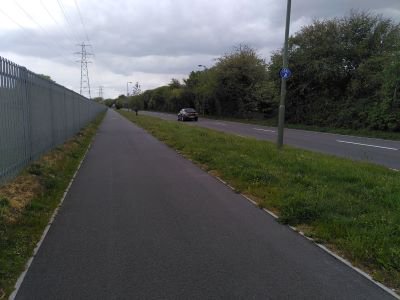
Greenways
A 'greenway' is a name often given to a cycle facility that is away from the road altogether. Greenways can be cycle tracks but are often bridleways or byways with a surface suitable for cycling, or wide paths that are technically footpaths and cycle tracks adjacent to one another.
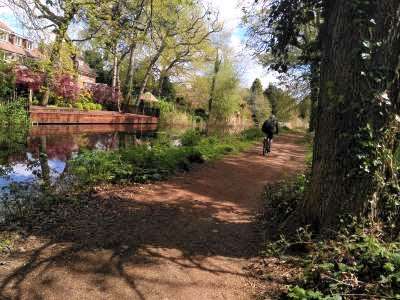
Quiet streets and lanes
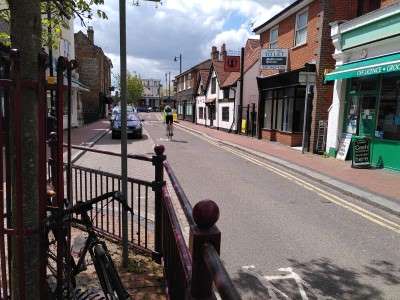
On quiet streets and lanes, where traffic flows and speeds are both low, it is normally comfortable for bicycle users to share the carriageway with other vehicles. This can be supported with traffic calming measures as appropriate.
Supporting infrastructure
In addition to providing facilities for travelling along a route, supporting infrastructure at specific points along a route can help make it easier to cycle, including:
- crossing points
- junction improvements
- wayfinding (information to help you navigate)
- transition features (where one cycle facility meets another)
- cycle parking
- traffic calming